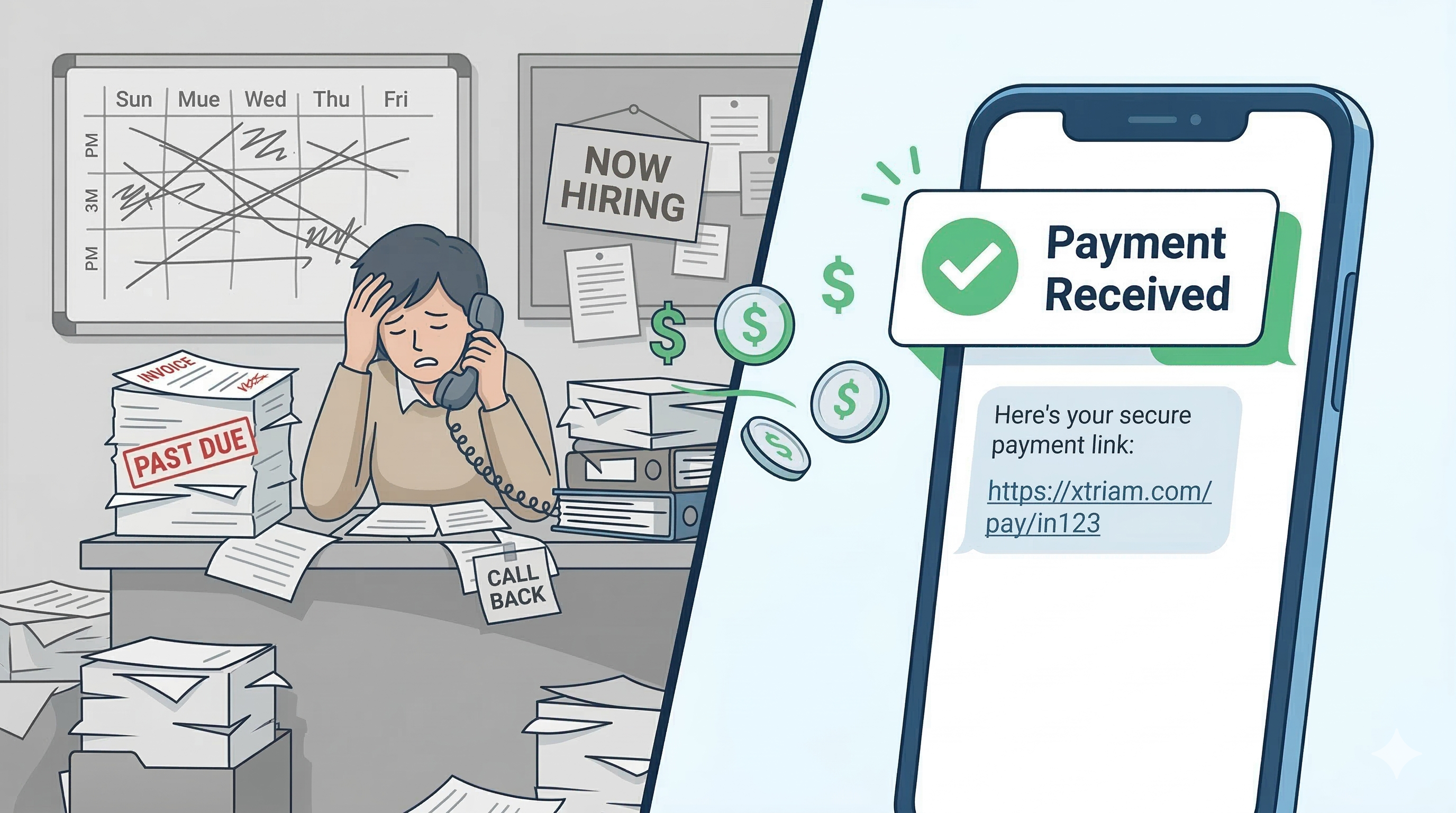
It's 4 PM on a Thursday. You finished an installation three weeks ago. The customer was happy. The job went smoothly. And you still haven't been paid.
So you call. Voicemail. You text. No response. You email. Nothing. You make a note to follow up again Monday. Monday comes, and you've got three new jobs to worry about, so the follow-up slips to Wednesday. Then Friday. Then you realize it's been six weeks.
Sound familiar? If you're a contractor, this isn't a bad month — it's most months.
The True Cost of Chasing Payments
Most contractors think of unpaid invoices as a cash flow problem. It is — but the damage goes deeper than the missing money. Let's break it down for a company doing 20 jobs a month:
Time cost: If your office person spends 15 minutes per follow-up call, and 30% of your jobs require at least two follow-ups, that's over 3 hours a week just chasing money. At $25/hr fully loaded, that's $3,900/year in labor spent on collection calls.
Cash flow cost: If your average job is $8,000 and payments come in 15 days late on average, you're carrying $80,000 in receivables at any given time. That's money you've already spent on materials and labor that you can't use for the next job.
Opportunity cost: Every hour spent on collections is an hour not spent on quoting, scheduling, or customer service. And every dollar sitting in receivables is a dollar you can't invest in growth.
Relationship cost: Nobody enjoys making collection calls. Not you, not your office staff, and definitely not your customers. Every call is an awkward conversation that chips away at the relationship — even when the customer has every intention of paying.
Why Traditional Collection Methods Fail
The typical contractor collection process looks something like this:
- Send a paper invoice or PDF by email
- Wait 30 days
- Call when the payment is late
- Leave a voicemail
- Call again a week later
- Send another email with "gentle reminder" in the subject line
- Finally get paid — or write it off
This process fails for three reasons:
Friction. The customer has to receive your invoice, figure out how to pay (write a check? call with a card number?), and actually do it. Each step is a chance for the payment to stall. Most customers aren't avoiding you — they're just busy, and your invoice isn't the easiest thing on their to-do list.
Inconsistency. Follow-ups depend on someone remembering to make the call. When the office is busy — and the office is always busy — collection calls are the first thing that gets pushed to tomorrow.
No system of record. Without a centralized system tracking who owes what and when the last follow-up was, payments fall through the cracks. You end up with a mix of notes on sticky pads, texts you can't find, and a vague feeling that "someone still owes us money."
The Fix: Remove the Friction, Automate the Follow-Up
The fastest way to get paid isn't to chase harder. It's to make paying so easy that the customer does it the moment they see the invoice.
Here's what that looks like in practice:
Step 1: Payment links instead of invoices. Instead of sending a PDF and hoping the customer mails a check, send a payment link by text message. The customer taps the link, sees the amount and job details, and pays by credit card or ACH in under 60 seconds. No app to download. No account to create. Just tap, pay, done.
Step 2: Automatic payment milestones. When a contract is signed, the system creates the payment schedule automatically — deposit, progress payment, final balance. Each milestone triggers a payment request at the right time. No one has to remember.
Step 3: Automated reminders. If a payment isn't received within a set window, the system sends a polite reminder — with the payment link included. No phone call. No awkward conversation. Just a consistent, professional nudge.
Step 4: Real-time visibility. Every payment posts automatically to the project record and syncs to your accounting software. You know exactly what's been collected, what's outstanding, and what's overdue — without asking anyone or checking a spreadsheet.
What Happens When You Make This Switch
A window installation company in South Florida was averaging 18 days to collect final payments. Their office manager spent 2–3 hours daily on collection calls — which meant she wasn't scheduling jobs, coordinating crews, or handling customer service. The owner was frustrated, the office manager was burned out, and cash flow was unpredictable.
After implementing payment links through bpmPro's Stripe integration, the average collection time dropped to 4 days. Most customers paid the same day they received the link. The office manager reclaimed 10+ hours a week. And the awkward phone calls? Gone.
The math: if you collect $800,000/year in project revenue and cut your average collection time from 18 days to 4 days, you free up roughly $30,000 in working capital at any given time. Add the labor savings from eliminated collection calls, and the total impact is over $50,000/year.
The Psychology of Getting Paid
Here's something most contractors don't think about: the moment of highest payment intent is right after the work is done. The customer is happy. They see the result. They want to pay you.
But if you wait three days to send an invoice, that moment passes. Life happens. Other bills come in. Your invoice gets buried in an email inbox. By the time you follow up two weeks later, the urgency is gone.
The solution is simple: collect payment at the moment of completion. Send the payment link while you're still on-site or immediately after the crew finishes. The customer's satisfaction is at its peak, paying is easy, and you get your money the same day.
Stop Chasing. Start Automating.
Chasing payments is one of the most expensive habits in the contracting business — and one of the most unnecessary. The technology to automate collections isn't future tech. It's available today. It's affordable. And for the contractors using it, the results are immediate.
If your office is spending hours every week on collection calls, you're not just losing time — you're losing money, relationships, and the opportunity to focus on work that actually grows the business.
bpmPro handles payments, milestones, and automated reminders so your team never has to make another collection call. Book a free demo and see how much time and cash flow you can recover.
Related: How we automate the back office for contractors | Our 20+ years in the window & door industry