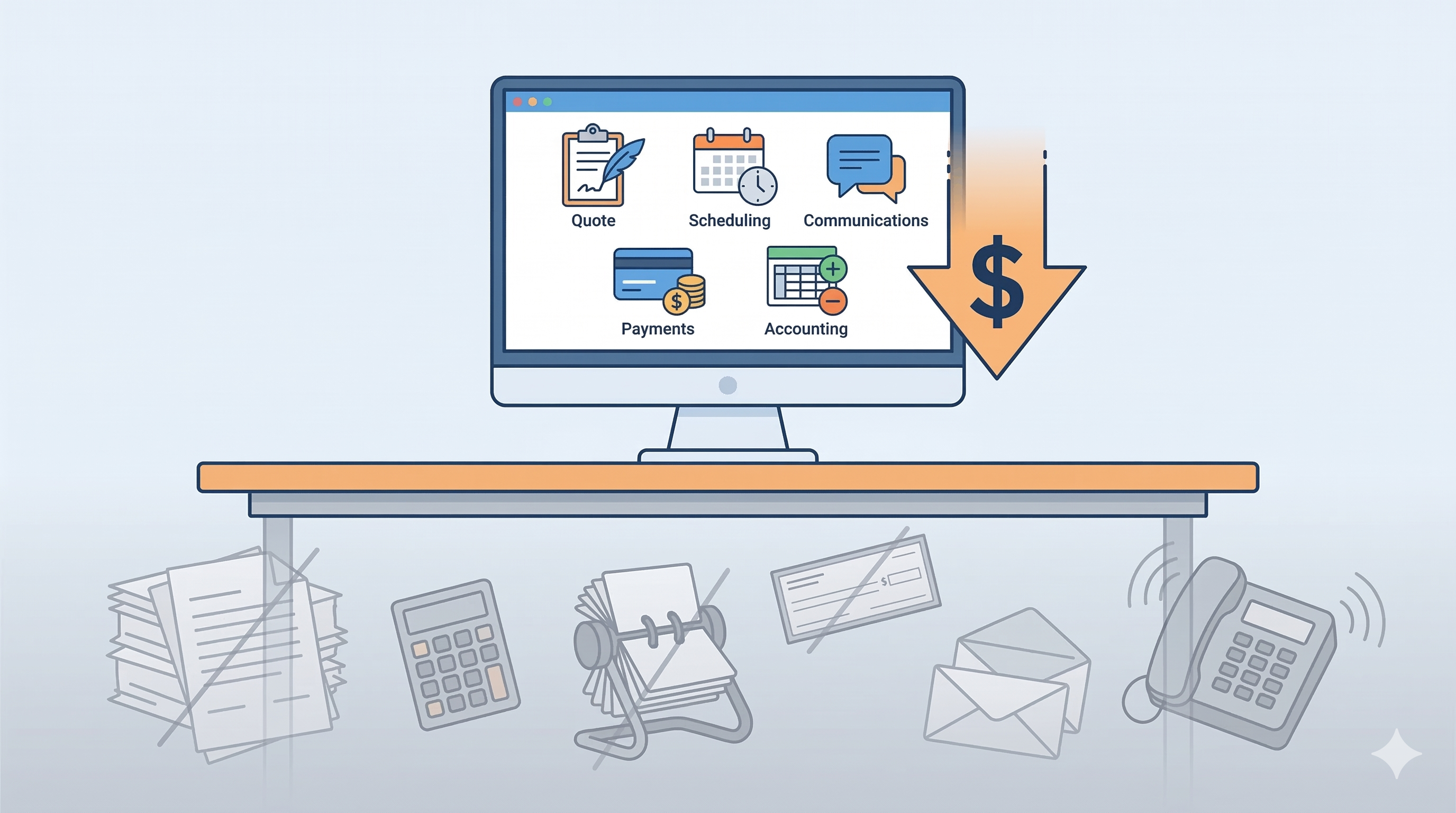
Ask any contractor what keeps them up at night and the answer is usually the same: overhead. Not materials — those get marked up and passed through. Not crew labor — that's tied to revenue. It's the office. The admin staff. The coordinator. The bookkeeper. The hours the owner spends on paperwork instead of selling or supervising jobs.
Office overhead is the silent killer of contractor profit margins. It doesn't show up as a line item on a job estimate, but it erodes every dollar of profit you earn. And for most small to mid-size contractors, it's growing faster than revenue.
Where the Money Actually Goes
Let's look at a typical window and door contractor doing $2M in annual revenue with 3 office staff and 4 field crews:
Office salaries: $130,000–$170,000/year (office manager, coordinator, part-time bookkeeper)
But the salary line is only part of the cost. The real expense is in what those people spend their time doing:
- Quoting: Estimators spend 30–60 minutes per quote building proposals in Excel. At 6–8 quotes per day across 2 estimators, that's 40+ hours/week just on quoting.
- Data entry: Job details, customer info, payment records — entered into one system, then re-entered into QuickBooks. Double entry eats 8–10 hours/week.
- Customer communication: Answering "Where is my order?" calls, sending appointment confirmations, emailing contract documents. At 15–20 inbound calls per day, this consumes an entire person.
- Payment collection: Calling customers about overdue balances, processing checks, reconciling payments. Adds 5–10 hours/week.
- Scheduling: Coordinating crews, tracking permits, managing material deliveries — often through text messages and a whiteboard. Takes 5+ hours/week.
Add it up and you've got 70–80 hours/week of office work. That's nearly 2 full-time employees — just on processes that could be automated.
The 5 Biggest Overhead Drains (and How to Fix Them)
1. Manual Quoting
The problem: Every quote is built from scratch in a spreadsheet. Pricing is looked up from a price list. Tax rates are calculated manually. Margins are estimated. The quote gets emailed as a PDF, then someone waits for a callback.
The fix: A CPQ (Configure, Price, Quote) system that pulls from your product catalog, applies pricing rules automatically, and generates a branded proposal in minutes. When the customer says yes, the quote converts to a contract — no re-entry, no duplicate data.
The savings: Quoting time drops by 75%. An estimator doing 6 quotes/day saves 3+ hours daily. That's 15+ hours/week per estimator — time they can spend in front of more customers.
2. Double Data Entry
The problem: Customer info lives in the CRM. Job details live in a spreadsheet. Financial data lives in QuickBooks. Someone is manually copying data between systems — and making errors along the way.
The fix: A single system where the quote, the contract, the project, the payments, and the accounting all flow from one record. When a quote converts to a contract, the project creates automatically. When a payment is received, it posts to the project and syncs to QuickBooks. Zero re-entry.
The savings: Eliminates 8–10 hours/week of data entry and the errors that come with it. At $25/hr, that's $13,000/year in recovered productivity.
3. Manual Customer Communication
The problem: Customers call to ask about their order status. Your office staff looks it up, calls them back, and repeats this 15–20 times a day. Meanwhile, appointment confirmations, welcome emails, and completion surveys are sent manually — or not at all.
The fix: Automated SMS and email triggers at every project stage. Order confirmed? Customer gets a text. Materials received? Customer gets an email. Installation scheduled? Automatic reminder 48 hours before. Your staff doesn't touch any of it.
The savings: "Where is my job?" calls drop by 80%. That frees up 2–3 hours/day — roughly $15,000/year in labor — and your customers actually feel more informed.
4. Manual Payment Collection
The problem: You send a paper invoice or PDF. The customer forgets. You call to remind them. They say they'll mail a check. The check takes a week. You deposit it. Then you enter the payment in QuickBooks. Total cycle: 15–30 days.
The fix: Send a payment link by text or email. The customer clicks, pays by card or ACH, and the payment posts automatically to the project record and your accounting software. Average collection time: 4 days.
The savings: Eliminates 5–10 hours/week of collection calls. Cuts average collection time from 18 days to 4 days. For a company collecting $800K/year, that frees up $30,000+ in working capital at any given time.
5. Whiteboard Scheduling
The problem: Crew schedules live on a dry-erase board or in a shared calendar. The operations manager spends the first hour of every day making calls to figure out who's going where. Changes happen by text message. Things get missed.
The fix: Jobs auto-populate into a scheduling queue when contracts are signed. Crews are assigned based on availability and skill. Everyone sees their assignments on mobile. Changes update in real time.
The savings: Ops manager reclaims 5+ hours/week. Double-bookings and missed assignments drop to zero. Crew utilization improves because you can actually see what's available.
The Total Impact
When you add up the savings across all five areas:
- Quoting: 15+ hours/week recovered
- Data entry: 8–10 hours/week eliminated
- Customer communication: 10–15 hours/week automated
- Payment collection: 5–10 hours/week removed
- Scheduling: 5+ hours/week saved
That's 40–55 hours per week — the equivalent of a full-time employee — freed from manual processes. At an average fully-loaded cost of $25/hr, that's $52,000–$71,500/year in overhead savings.
And here's the important part: you didn't fire anyone. Your existing team is now doing higher-value work — closing more deals, serving customers better, keeping projects on track — instead of copying data between spreadsheets and making collection calls.
Start With the Biggest Drain
You don't have to automate everything at once. Look at where your office team spends the most time on repetitive work. For most contractors, it's quoting or customer communication. Start there. See the results. Then expand.
bpmPro was built for this. It started as an internal tool at a window and door company that was drowning in the same overhead you're dealing with. Today it handles quoting, scheduling, project accounting, payments, and communications — all from one platform built on Salesforce.
Want to see how much overhead you could cut? Try our savings calculator or book a free demo.
Related: How we automate the back office for contractors | Our 20+ years in the window & door industry