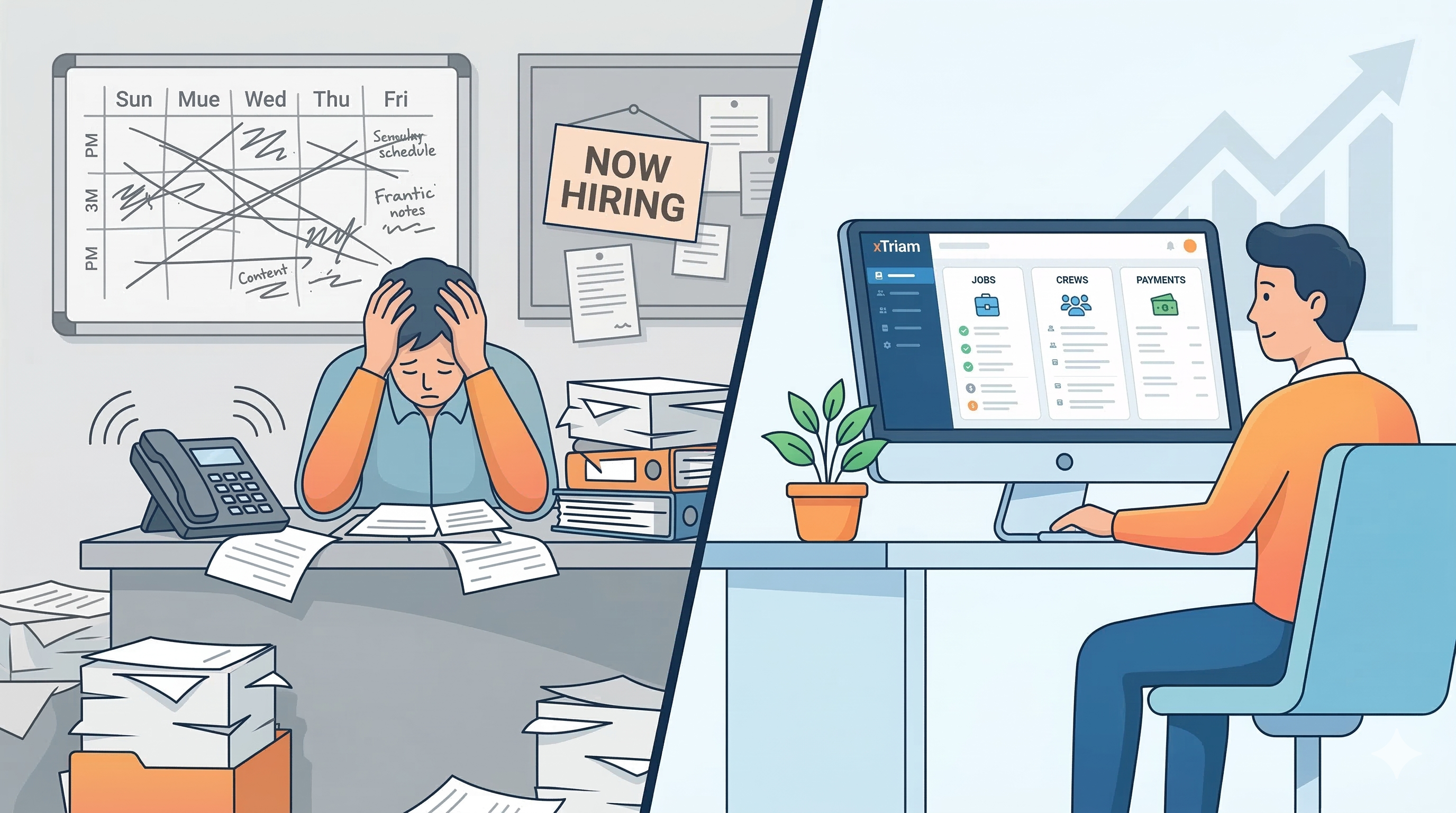
You're closing more deals. Jobs are stacking up. Your crews are busy. That should feel like progress — and it does, until you realize the bottleneck isn't in the field. It's in the office.
Every new job means more quotes to write, more payments to chase, more schedules to coordinate, and more customer calls to return. So you do what most contractors do: you think about hiring another office person. Maybe a part-time admin. Maybe a coordinator. Someone to keep things from falling through the cracks.
But here's the problem: that hire costs $35,000–$50,000 a year with burden — and they can only handle so much before you need another one. You're not solving the problem. You're just adding payroll to manage it.
The Real Problem Isn't Headcount — It's Process
Most small contracting businesses hit a growth ceiling between $1M and $3M in revenue. Below that, the owner and one or two office people can handle everything. Above that, things start breaking — quotes go out late, follow-ups get missed, invoices pile up, and the owner spends more time managing the office than running the business.
The instinct is to hire. But the root cause is almost always the same: too many manual processes eating up too many hours.
Consider what a typical office person does in a day at a window and door company:
- 45 minutes building or revising quotes in Excel or Word
- 30 minutes answering "Where is my order?" calls from customers
- 20 minutes chasing payments by phone or email
- 15 minutes updating the schedule on a whiteboard or shared calendar
- 30 minutes entering data into QuickBooks that already exists somewhere else
- 20 minutes sending confirmation emails and appointment reminders manually
That's nearly 3 hours a day — over 15 hours a week — on tasks that software can handle automatically. Multiply that by $25/hr fully loaded, and you're spending $19,500 a year on work that doesn't require a person.
What "Scale Without Hiring" Actually Looks Like
Scaling without adding headcount doesn't mean working your existing team harder. It means removing the manual work that's consuming their time so they can handle a larger volume of jobs without burning out.
Here's what changes when you automate the back office:
Quoting takes 10 minutes instead of 45. A CPQ (Configure, Price, Quote) system pulls from your product catalog, applies the right pricing and tax rates, and generates a branded PDF proposal. Your estimator picks the products, clicks generate, and sends it — while still at the customer's house. No going back to the office to "type it up."
Customer updates happen automatically. When an order ships, the customer gets a text. When installation is scheduled, they get an email. When the job is done, they get a satisfaction survey. Your office staff doesn't have to remember any of it — the system triggers the right message at the right time. Those 15–20 daily "Where's my job?" calls? They drop by 80%.
Payments collect themselves. Instead of calling customers to remind them about a balance, the system sends a payment link by text or email. The customer clicks, pays by card or ACH, and the payment records automatically in the project file. Collections that used to take 18 days now average 4.
Scheduling connects to the pipeline. When a contract is signed, the job enters the scheduling queue. You see every crew, every job, and every dependency in one view. No more whiteboards. No more group texts. No more double-booking.
The Math: Hiring vs. Automating
Let's compare the two paths for a contractor doing $2M in revenue who needs to handle 30% more volume:
Option A: Hire an office coordinator
- Salary + benefits: $42,000–$50,000/year
- Training time: 2–3 months to full productivity
- Management overhead: 3–5 hours/week of the owner's time
- Capacity ceiling: Hits the same wall again at the next growth stage
Option B: Automate manual processes
- Software cost: A fraction of a full-time salary
- Time savings: 15–20 hours/week across the team
- Capacity increase: Existing staff handles 30–50% more volume
- Scalability: The system handles the same workload whether you do 50 jobs or 150
The hire gives you one more person doing manual work. The automation removes the manual work entirely — and it doesn't call in sick, forget a follow-up, or need training on your pricing structure.
What a Typical Day Looks Like After Automation
Here's a real scenario from a South Florida window dealer running bpmPro:
7:30 AM — The operations manager opens the dashboard and sees every job scheduled for the week, crew assignments, and open dependencies (permits pending, materials in transit). No phone calls needed.
9:00 AM — An estimator finishes a site visit, configures the quote on his tablet, and sends the proposal to the homeowner before leaving the driveway. The customer signs electronically. The job auto-creates in the system.
11:00 AM — A customer's windows arrive at the warehouse. The system texts the customer: "Your order has arrived. Our team will contact you within 48 hours to schedule installation." No one in the office typed or sent that message.
2:00 PM — An installation wraps up. The system sends the final invoice with a Stripe payment link. The customer pays from their phone within an hour. The payment posts to the project, updates the balance, and syncs to QuickBooks. The office manager never touches it.
4:00 PM — The owner reviews a dashboard showing gross profit by job, crew utilization, and outstanding receivables. Decisions that used to require pulling data from three different systems now take 60 seconds.
This team didn't hire anyone new. They just stopped doing work that a system should be doing.
The Growth Trap to Avoid
The most expensive mistake growing contractors make is adding people to manage broken processes. If your quoting process takes 45 minutes because you're using Excel, hiring a second estimator doesn't fix the process — it just doubles the inefficiency.
Fix the process first. Then grow.
The contractors we work with who grow fastest are the ones who automate before they hire. They reach $3M, $5M, even $8M in revenue with the same office staff they had at $1.5M — because the software handles the volume, not the people.
Start Here
If your office team is overwhelmed and you're thinking about hiring, take 30 minutes to audit where the time actually goes. You'll probably find that 40–60% of their day is spent on tasks that don't require human judgment — data entry, follow-ups, status updates, payment chasing.
That's the work to automate. That's how you grow without adding overhead.
bpmPro was built for exactly this — by someone who ran a window and door company and hit the same growth ceiling. Book a free demo and see how much of your office workload can be automated.
Related: How we automate the back office for contractors | Our 20+ years in the window & door industry