Most window and door contractors get their first few jobs through word of mouth. A neighbor sees the work. A friend gives a referral. Business grows. And then it plateaus.
At some point, referrals alone can't sustain the growth you need. You're doing great work, but your phone isn't ringing enough. You try running a Facebook ad, maybe boost a post, maybe pay for a lead service — and the results are inconsistent at best.
The problem isn't that window and door contractor marketing doesn't work. The problem is that most contractors are using tactics without a system behind them. They generate leads but don't follow up fast enough. They get reviews but don't use them strategically. They have a website but it doesn't show up when someone searches "window replacement near me."
After working with window and door contractors since 2003, here are seven marketing strategies that consistently produce results — not theory, but what actually works in the field.
1. Own Your Google Business Profile
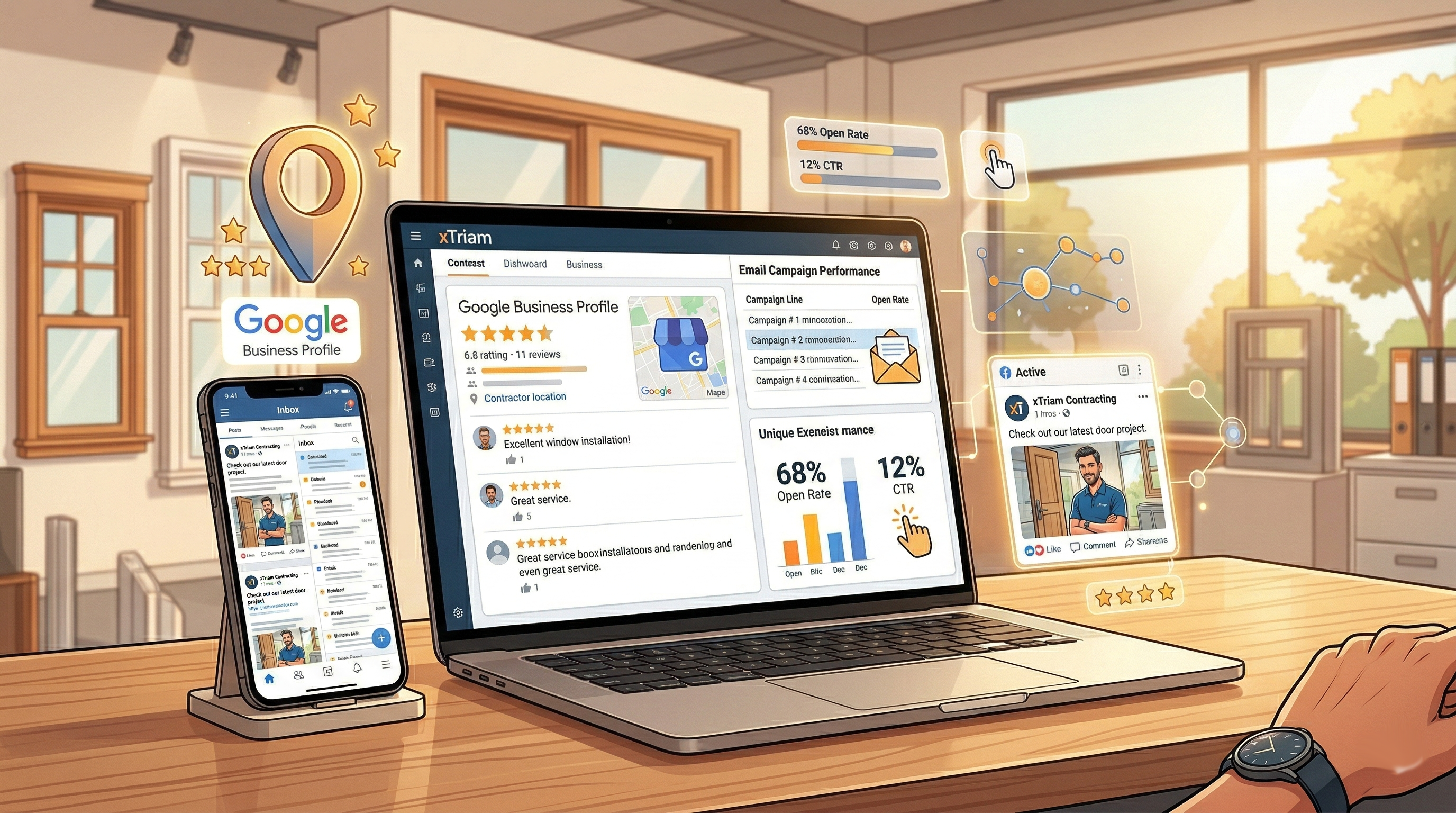
If you do nothing else on this list, do this. Your Google Business Profile (GBP) is the single most important piece of marketing for window companies that sell to homeowners in a local market.
When someone searches "window contractor near me" or "impact window installation Miami," Google shows the Map Pack — three local businesses with ratings, photos, and contact info — before any website results. If you're not in that top three, you're invisible to the majority of local searchers.
Here's what separates the contractors who show up from the ones who don't:
Complete every field. Business hours, service area, categories (use "Window Installation Service" as your primary), attributes, and a detailed business description that includes the cities you serve. Google rewards completeness.
Post weekly. Google Business Profile has a "Posts" feature that most contractors ignore. Share a completed job photo every week with a short description: "Impact window installation in Coral Gables — 12 PGT WinGuard units, completed in one day." These posts signal to Google that your business is active.
Add photos consistently. Businesses with more than 100 photos get 520% more calls than the average listing, according to Google's own data. Take before-and-after photos of every job and upload them weekly. This is one of the easiest ways to generate window contractor leads without spending a dollar on ads.
2. Build a Review Engine
You already know reviews matter. But the difference between a contractor with 40 reviews and one with 200 reviews is not luck — it's a system.
Here's the system that works: send a review request within 2 hours of completing a job. Not a week later. Not when you remember. Within 2 hours, while the customer is still looking at their new windows and feeling good about the decision.
The easiest way to do this is with an automated text message. When the job status changes to "Complete" in your CRM, the customer gets a text with a direct link to your Google review page. No extra steps for your team. No "I'll remind them later" that never happens.
Contractors using automated review requests typically see a 3–5x increase in review volume within six months. And volume matters more than perfection — a business with 180 reviews at 4.6 stars outranks one with 12 reviews at 5.0 stars every time.
Respond to every review. Yes, every one. Thank positive reviewers by name and mention the specific work ("Glad you're happy with the PGT sliding doors, Maria!"). For negative reviews, respond professionally and take the conversation offline. Google's algorithm factors in response rate.
3. Invest in Local SEO — Not Just a Website
Having a website is table stakes. Ranking that website for the searches your customers actually make is where the value is.
Marketing for window companies should focus on local, intent-driven keywords. People don't search "best window company in America." They search "impact window installation Broward County" or "window replacement cost Miami-Dade." Your website needs pages that match these searches.
Here's a practical approach:
Create a page for each service. Don't lump everything on one "Services" page. Have dedicated pages for "Impact Window Installation," "Sliding Glass Door Replacement," "Window Repair," and "Commercial Storefront Windows." Each page should be 500+ words with relevant photos from actual jobs.
Create location pages. If you serve 8 cities, create a page for each one. "Window Installation in Coral Gables" should be its own page with local references, photos from jobs in that area, and your Google Business Profile embedded.
Blog consistently. One post per month about a topic your customers search for. "How much do impact windows cost in Florida?" or "Do impact windows lower insurance premiums?" These posts bring in organic traffic for months or years after you publish them.
4. Use Before-and-After Content Everywhere
This is the most underused marketing asset in the window and door industry. Every job you complete is a piece of content waiting to happen.
Before-and-after photos work because they show the transformation — and that's what homeowners are buying. They're not buying glass and vinyl. They're buying the feeling of a better-looking, safer, more energy-efficient home.
Here's how to systematize it:
Make it part of the job process. Train your crews to take a "before" photo when they arrive and an "after" photo when they finish. Make it as routine as clocking in. If you use a CRM, attach the photos to the job record so they're organized and easy to find later.
Post to multiple channels. The same before-and-after photo can go on your Google Business Profile, Instagram, Facebook, your website gallery, and in a follow-up email to past customers. One photo, five touchpoints.
Add context. Don't just post the photos — tell the story. "This Kendall homeowner replaced 14 single-pane windows with PGT WinGuard impact windows. The job took two days and qualified for an insurance discount of $1,200/year." Specific details build credibility and help with SEO.
5. Run Targeted Advertising That Tracks to Revenue
Most window and door advertising fails because contractors treat it like a billboard — blast a message to everyone and hope some of it sticks. That's how you burn $2,000 a month with nothing to show for it.
Effective window and door advertising is targeted, measurable, and connected to your sales process.
Google Ads for high-intent searches. If someone searches "impact window installation near me," they're ready to buy. A Google Search ad targeting that keyword in your service area puts you in front of the right person at the right time. Budget $500–$1,500/month and track every lead to see your actual cost per job sold — not just cost per click.
Facebook/Instagram for awareness and retargeting. Social ads work best when they keep you top of mind. Show before-and-after photos to homeowners in your service area. Then retarget people who visited your website but didn't call. This combination — Google for intent, social for awareness — covers both ends of the buying journey.
Track everything back to revenue. This is where most contractors drop the ball. You spend $1,200 on Google Ads and get 30 leads. How many became quotes? How many closed? What was the revenue? If you can't answer those questions, you're flying blind. A CRM that tracks leads from source to close makes window and door advertising measurable — and that's when it starts making money. bpmPro does exactly this, tracking every lead from first click to final payment so you know which marketing channels actually produce revenue.
6. Build a Referral Program With Structure
Referrals are your best leads. They close faster, negotiate less, and have higher lifetime value. But most contractors treat referrals as something that happens to them, not something they build.
A structured referral program turns happy customers into a predictable lead source.
Ask at the right time. The best time to ask for a referral is right after the customer expresses satisfaction — when they say "I love these windows" or leave a 5-star review. That's the moment to say, "We'd love to help your neighbors too. Here's a referral card."
Make the incentive meaningful. A $50 gift card is fine. A $200 credit toward future work is better because it brings them back. Some contractors offer $100 to the referrer and $100 off to the new customer — everybody wins.
Track every referral. If you don't track where referrals come from, you can't thank the right people or know which customers are your best advocates. Log every referral source in your CRM. Over time, you'll find that 10–15% of your customers generate 60–70% of your referrals. Those are your VIPs — treat them accordingly.
Realtors and property managers. Don't limit referrals to homeowners. Realtors who sell homes often recommend window upgrades. Property managers need reliable contractors for multi-unit replacements. Build relationships with 5–10 realtors in your market and check in quarterly. A single realtor who sends you three jobs a year is worth more than most ad campaigns.
7. Follow Up Fast — Or Lose the Lead
Here's the stat that should change how you think about window contractor leads: contractors who respond to an inquiry within 5 minutes are 10x more likely to make contact than those who wait 30 minutes. Wait an hour, and your odds drop by over 90%.
Most of the marketing strategies above are about generating leads. This one is about not wasting the leads you already get.
When a homeowner fills out a "Get a Quote" form on your website at 7 PM on a Tuesday, they're probably also filling out forms on two or three other contractor sites. The first company to call back wins the appointment 78% of the time. Not the cheapest. Not the one with the best reviews. The first one to respond.
Automated lead response makes this possible without someone sitting by the phone 24/7. When a new lead comes in, the system can:
- Send an immediate text: "Thanks for reaching out to [Company Name]. We got your request and will call you within the hour."
- Notify your sales rep by text and email with the lead details
- Create a task to follow up if no contact is made within 15 minutes
- Log the lead source so you know which marketing channel produced it
This is where your CRM becomes a marketing tool, not just a database. The speed and consistency of your follow-up determines whether your marketing dollars produce revenue or just clicks. With bpmPro, new leads trigger instant notifications and automated responses so no inquiry goes unanswered — even at 9 PM on a Saturday.
Putting It All Together
Effective window and door contractor marketing isn't about doing one thing well. It's about building a system where each piece reinforces the others:
- Your Google Business Profile drives local visibility
- Your reviews build trust before you ever talk to the customer
- Your SEO brings in leads month after month without ongoing ad spend
- Your content shows the quality of your work
- Your advertising fills gaps and targets high-intent buyers
- Your referral program turns customers into advocates
- Your follow-up speed converts leads into revenue
The contractors who grow consistently aren't necessarily doing more marketing. They're doing it with a system that captures every lead, tracks every touchpoint, and closes the loop between marketing spend and actual revenue.
That's exactly what we built bpmPro to do. It's a CRM for window and door contractors that manages the entire customer journey — from the first inquiry to the final payment. Every lead tracked. Every follow-up automated. Every marketing dollar accountable.
Book a free demo and see how it works for your business. Or check out how other contractors are using it on our customer success stories page.